
ResearchRabbit vs Consensus
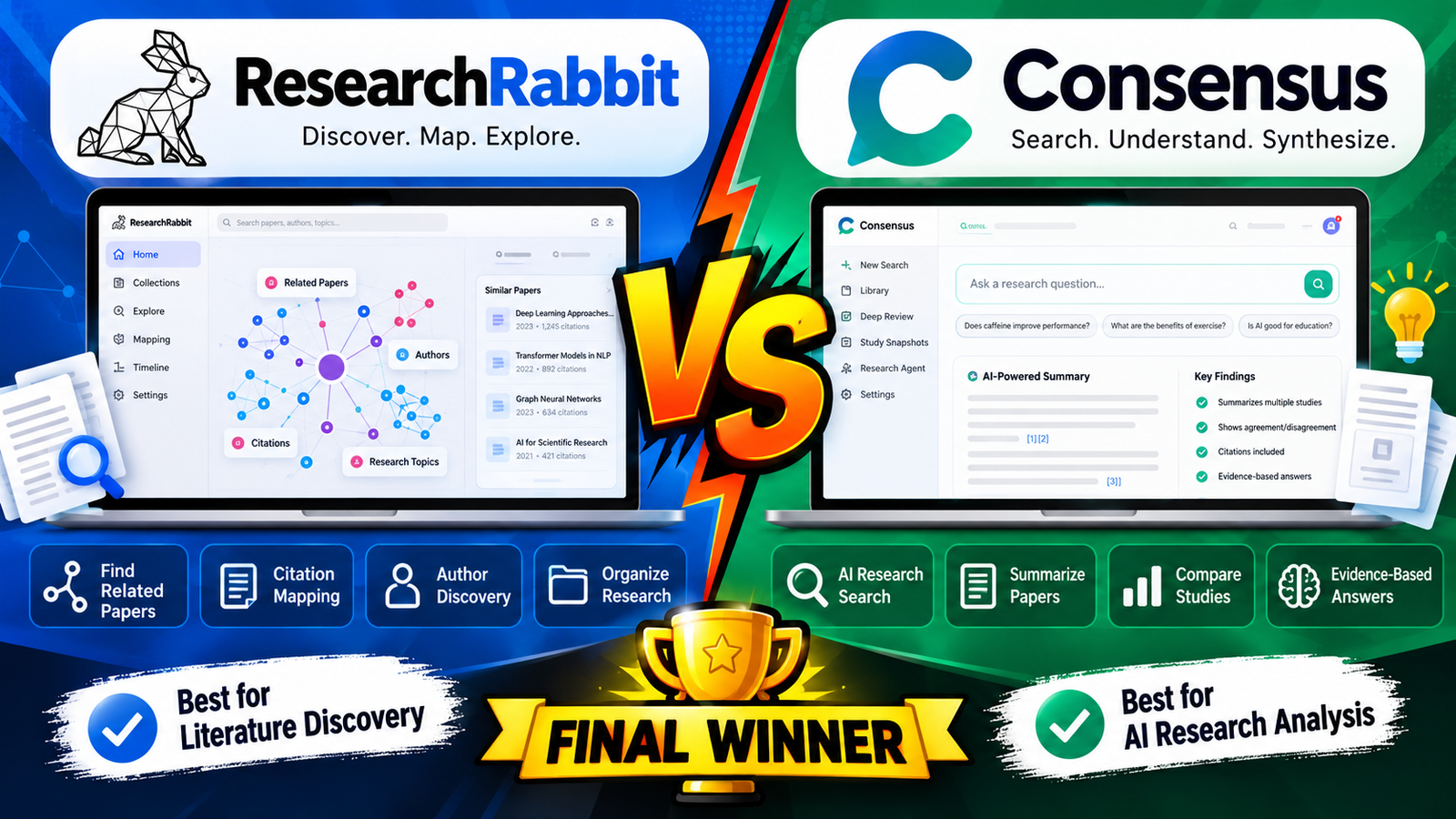
ResearchRabbit vs Consensus
Which academic research tool is right for you? We compared literature discovery, citation mapping, AI synthesis, pricing and more.
Best for literature discovery & citation mapping
Best for AI-powered research synthesis & answers
01 Quick Comparison
| Feature | ResearchRabbit | Consensus |
|---|---|---|
| Main Purpose | Discover & organize literature | Search, understand & synthesize |
| AI-Powered Answers | Limited | Yes |
| Academic Paper Search | Yes | Yes |
| Citation Mapping | Excellent | Available, not core focus |
| Visual Research Maps | Yes | Limited |
| Similar-Paper Discovery | Excellent | Yes |
| Natural-Language Questions | Yes | Excellent |
| Research Summaries | Limited | Excellent |
| Compare Multiple Studies | Limited | Yes |
| Consensus / Agreement Analysis | No | Yes |
| Deep Literature Reviews | Discovery-focused | Yes |
| PDF / Paper Analysis | Organization-focused | Yes |
| Collections / Library | Excellent | Yes |
| Zotero Integration | Yes | Library features available |
| Collaboration | Yes | Yes / team plans |
| Best for Literature Review | Excellent | Excellent |
| Best for Quick Answers | Good | Excellent |
| Best for Citation Networks | Excellent | Good |
| Best for Evidence-Based Answers | Good | Excellent |
ResearchRabbit says it provides access to more than 310 million academic papers, while Consensus says its database contains more than 220 million peer-reviewed papers.
02 Pricing Comparison
| Plan | Price | Highlights |
|---|---|---|
| ResearchRabbit Free | $0 | Unlimited searches, up to 50 seed articles, visual maps, Zotero import |
| ResearchRabbit+ | $10/mo ($12.50/mo shown for annual) | Up to 300 seed articles, advanced search, multiple projects |
| Consensus Free | $0 | Unlimited Papers search, 3 Deep Reviews/mo, 10 Study Snapshots/mo |
| Consensus Pro | $20/mo ($12/mo billed annually) | Unlimited Pro messages, 15 Deep Reviews/mo, unlimited Study Snapshots |
| Consensus Deep | $65/mo ($45/mo billed annually) | 200 Deep Reviews/mo, 1,000 API/MCP calls/mo |
ResearchRabbit's free tier is explicitly intended to remain available permanently and is generous for literature discovery. Consensus Free is better if you want AI-assisted answers rather than a large exploration allowance.
03 Which Fits Your Need?
| Need | Better Fit | |
|---|---|---|
| Finding Papers | Both | |
| Finding Related Papers | ResearchRabbit | |
| Understanding Citation Networks | ResearchRabbit | |
| Finding Important Authors | ResearchRabbit | |
| Organizing Papers | ResearchRabbit | |
| Asking Questions in Plain English | Consensus | |
| Getting Paper Summaries | Consensus | |
| Comparing Studies | Consensus | |
| Understanding Research Findings | Consensus | |
| Evidence-Based Answers | Consensus | |
| Deep Research Synthesis | Consensus | |
04 Pros & Cons
Pros
- Excellent visual citation mapping & discovery
- Extremely generous permanent free tier
- Strong collections, notes & Zotero integration
- Great for building a comprehensive literature review
- Access to 310M+ academic papers
Cons
- Limited AI-generated synthesis or summaries
- Not built for direct question-answering
- Less useful for comparing study findings
- No consensus/agreement analysis across papers
Pros
- Excellent AI-powered research synthesis
- Answers research questions in plain language
- Deep Reviews & Study Snapshots for evidence analysis
- Compares studies & identifies agreement/disagreement
- Citations grounded in retrieved research papers
Cons
- Less specialized in visual citation-network exploration
- Free plan has limited Deep Reviews/Snapshots per month
- Higher monthly price than ResearchRabbit+
- Citation mapping is available but not the core focus
Final Winner: Consensus
As an all-around academic research assistant, Consensus covers more of the workflow — search → understand → compare → synthesize → cite — while ResearchRabbit stays more specialized around discover → map → organize → explore. But for literature discovery specifically, ResearchRabbit has the edge thanks to its citation mapping and iterative discovery design.