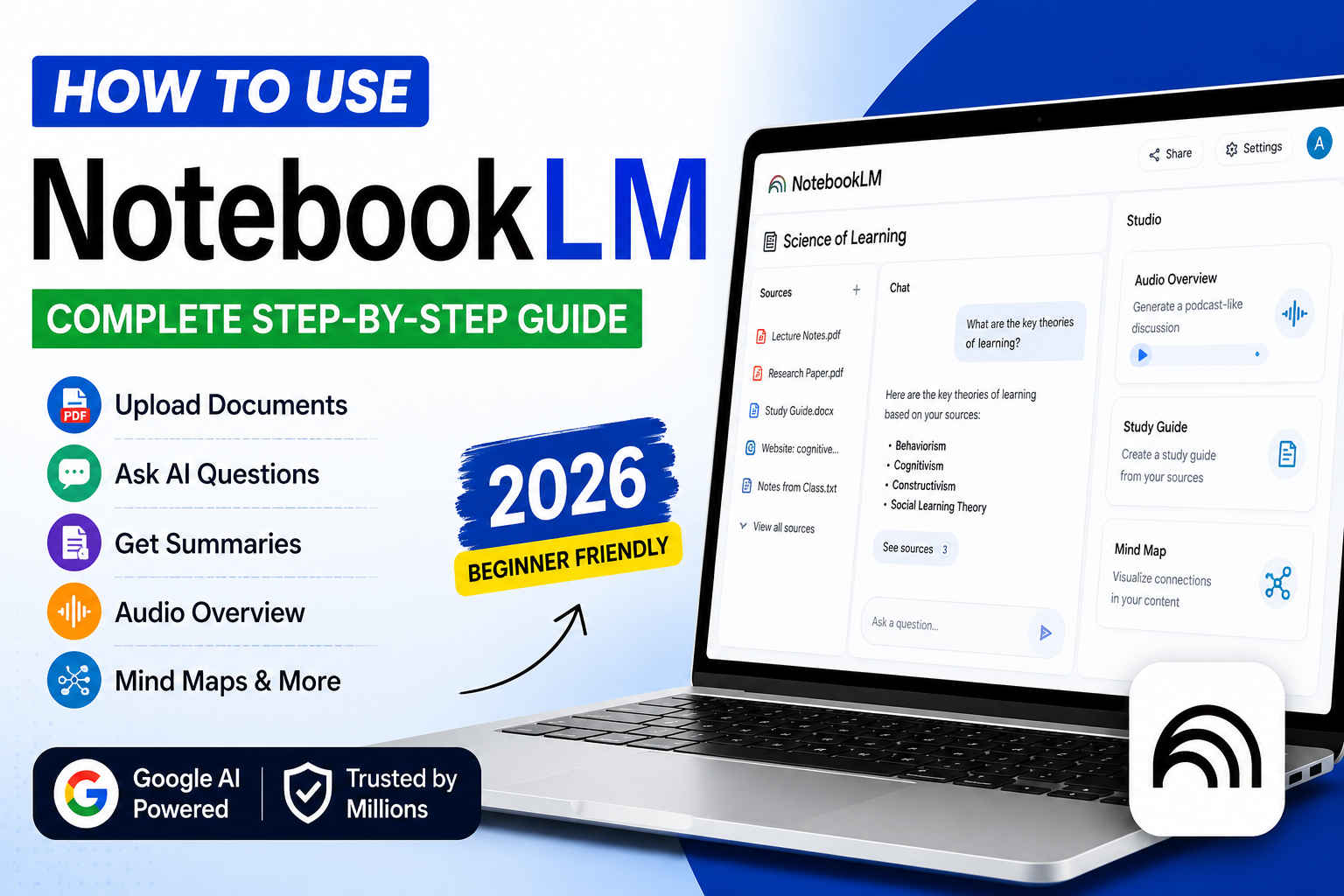
Ever wanted to upload a research paper or meeting notes and ask smart questions about them? Google NotebookLM turns your data into a smart knowledge base. It’s like having a personal research assistant, making complex info easy to understand.

Whether you’re a student, writer, or professional, this comprehensive resource has got you covered. You’ll learn to organize ideas, create summaries, and even make audio overviews. These tools can make managing your daily info much easier.
This notebooklm complete guide is for users in the United States looking to boost productivity in 2026. We’ll cover every key feature, so you can use the interface with confidence from start to finish.
Key Takeaways
- Learn to upload various document formats for instant AI analysis.
- Discover methods to generate accurate summaries and organize complex research.
- Explore the unique audio overview feature for better information retention.
- Master the interface to improve your personal and professional project management.
- Gain confidence in leveraging advanced AI tools for daily tasks.
What Is NotebookLM?
Imagine having a personal research assistant that understands every document you upload. NotebookLM is a sophisticated AI-powered research assistant developed by Google. It helps you synthesize information from various document types.
This platform uses advanced language models to provide context-aware answers. It generates responses based strictly on the specific sources you provide. This ensures high accuracy and relevance.
The google ai notebook functions as a private, secure environment for your data. You can feel confident knowing that your uploaded files remain protected. The system processes your complex queries securely.
This unique approach makes the notebooklm ai a leading choice for researchers and students alike. By focusing on your own documents, it transforms how you organize and analyze information. It is an essential ai note-taking tool for modern workflows.
Whether you are managing academic papers or business reports, the google ai notebook helps you extract insights quickly. It is designed to save you time while improving the quality of your research output.
NotebookLM Features at a Glance
Explore the unique notebooklm features to boost your productivity. This platform turns your digital documents into active helpers in your research. No more scanning pages by hand; the system does it for you.
The software’s main strength is intelligent document summarization. No need to spend hours on long reports to find the key points. The AI picks out the most important data, letting you dive into deeper analysis.
“The true power of artificial intelligence in research is not just finding information, but helping us understand the connections between disparate ideas.”
The tool shines in cross-document synthesis. Upload several files to see patterns and themes across them. It weaves a unified story from scattered data, a top notebooklm feature for experts.
The table below shows how NotebookLM beats traditional research:
| Capability | Traditional Method | NotebookLM Advantage |
|---|---|---|
| Document Analysis | Manual Reading | Instant Summarization |
| Data Synthesis | Fragmented Notes | Cross-Document Insights |
| Citations | Manual Tracking | Automated Generation |
| Interaction | Static Searching | Conversational Analysis |
Lastly, NotebookLM helps you create accurate citations from your files. This keeps your work solidly based on evidence and saves time. With these notebooklm features, your research library becomes a dynamic, talking partner.
NotebookLM Pricing
Ever wondered how much it costs to use such advanced AI tools? Right now, NotebookLM pricing is free. Google offers it for free to everyone.
This means you can try out cool AI features without spending a dime. It’s a great way to add innovative technology to your work without breaking the bank.
As it’s free AI software, you can dive into its features without worrying about costs. It’s perfect for students, researchers, and professionals.
Even though it’s free now, remember that AI costs can change. Google might add special plans for bigger needs in the future.
For now, you get to use all its features without limits. Keep up with updates to be ready if things change later.
System Requirements
Getting started with this AI tool is easy. It’s web-based, so you don’t need to install software or deal with complicated hardware. This makes it simple to use.
For the best experience, use a modern, updated web browser. Google Chrome, Mozilla Firefox, Microsoft Edge, and Safari are all supported. Make sure your browser is up to date to avoid problems.
A stable internet connection is also key. The tool works in the cloud, so a good connection is essential. Slow loading? Check your internet first.
You’ll need an active Google account to use the platform. This account lets you save and access your work on any device. Make sure you have this ready.
| Requirement Category | Recommended Specification | Importance Level |
|---|---|---|
| Web Browser | Latest version of Chrome, Edge, or Safari | High |
| Internet Speed | Broadband or stable 4G/5G connection | Medium |
| User Account | Active Google Account | Critical |
| Device Type | Desktop, Laptop, or Tablet | Medium |
How to Access NotebookLM
If you’re curious about how to use notebooklm, start by visiting the official site. You’ll need a basic Google account to begin. No special software is required to start exploring.
When you get to the website, sign in with your account details. It’s important to follow the notebooklm instructions carefully. This ensures a smooth start. You might also need to agree to the terms of service to keep your data safe.

After logging in, you’ll see the google notebooklm dashboard. This is your main area for managing projects and organizing your digital notes. From here, you can easily create your first notebook.
Getting started with how to use google notebooklm is straightforward. Keep your account active and your browser up to date. This helps the AI tools work their best. See the table below for a quick overview of what you need.
| Requirement | Description | Status |
|---|---|---|
| Google Account | Personal or Workspace email | Required |
| Web Browser | Chrome, Edge, or Safari | Recommended |
| Internet Access | Stable connection | Essential |
| Terms of Service | Acceptance of policies | Mandatory |
Best Prompt Examples
Learning to prompt your AI research assistant is key to getting the most out of it. By crafting your requests well, you can transform complex documents into clear insights. These notebooklm examples are a great starting point for your own use of the platform.
Start by being specific about what you want. Instead of asking for a general summary, ask for a bulleted list of key takeaways or a table comparing viewpoints. This helps the AI focus on the most important parts of your files.
Try using role-based prompts to change the tone of the AI’s output. Asking it to act as a subject matter expert or a professional editor can greatly enhance the quality of the response. Looking at different notebooklm examples will show you which prompts work best for your research.
| Prompt Category | Example Query | Expected Outcome |
|---|---|---|
| Summarization | “Summarize the main arguments in 5 bullet points.” | Concise overview of core concepts. |
| Comparative | “Compare the methodology of Source A and Source B.” | Structured analysis of differences. |
| Extraction | “List all dates and events mentioned in the text.” | Chronological data retrieval. |
| Creative | “Draft an email based on these research notes.” | Polished, ready-to-use content. |
Remember, you can refine your prompts if the first answer isn’t quite right. If the output is too wide, ask the AI to narrow its focus to a specific part of your source material. This back-and-forth is how you become a pro at using the platform.
Best Use Cases
This tool makes your daily tasks easier, from school to work. It’s designed to fit your needs, whether you’re a student, worker, or always learning.
Looking for a top notebooklm research assistant? It’s great at handling big documents. Learning how to use notebooklm for research lets you quickly summarize lots of texts.
Students often have trouble keeping up with notes and books. Upload your study materials to create a central place. This structured approach keeps you on track, even when you’re busy.
Professionals can also use it to manage big projects. Upload files like meeting notes and reports for quick answers. This significant time-saver lets your team work faster.
Using AI in your work gives you an edge. It turns documents into a living knowledge base. Consistency and organization are key benefits for your projects.
NotebookLM Tips & Tricks
Learning the advanced features of this platform can change how you work with documents. By following notebooklm best practices, you get the most accurate and relevant answers. High-quality inputs mean better outputs.
Exploring notebooklm tips and tricks can make your work easier. Start by cleaning your files to get rid of extra formatting or broken text. This helps the AI focus on what’s important.

One cool feature is making a notebooklm audio overview. It’s easy to learn how to generate audio overview in notebooklm. Just go to the notebook guide and choose the generate option. It turns complex documents into a natural-sounding summary.
“The greatest value of artificial intelligence lies in its ability to synthesize vast amounts of information into clear, actionable knowledge.”
If you like visual learning, try making a notebooklm mind map. Even though there’s no drawing tool, you can ask the AI to outline your sources. This makes it easier to see connections in text.
- Refine your sources: Use clear headings and bullet points in your uploaded documents.
- Iterative questioning: Ask follow-up questions to drill down into specific details.
- Cross-referencing: Upload multiple related documents to help the AI find patterns across different files.
Using these strategies will make you more efficient and productive. Treat your notebook as a dynamic workspace, not just a storage folder. Consistency is the key to mastering these tools.
Common Mistakes to Avoid
Mastering NotebookLM is more than just uploading files. It’s about using a smart approach to avoid common mistakes. Even those who are experienced can make errors that affect their AI research. Knowing these mistakes helps keep your results top-notch and precise.

One big mistake is uploading poorly formatted documents. If your files have broken text, messy tables, or scans that are hard to read, the AI will have a tough time. Make sure your PDFs or text files are clean and easy for machines to read before adding them to your notebook.
“The quality of your output is directly tied to the quality of your input. Garbage in, garbage out remains the golden rule of artificial intelligence.”
Another mistake is asking overly vague questions. Broad prompts often lead to generic answers that don’t offer much insight. To get the best results, aim to be as specific as you can with your questions.
Here are some tips to keep your workspace productive:
- Avoid information overload: Don’t upload too many unrelated documents at once. This can confuse the AI.
- Use clear prompts: Tell the AI what persona or format you want in its response.
- Verify the sources: Always check the citations the AI gives to make sure they’re right and in context.
By changing how you work, you can avoid these common problems. A clean, organized, and thoughtful approach is essential for getting the most out of your research projects.
NotebookLM vs ChatGPT
Both tools use AI, but in different ways. Your choice depends on your project goals and data needs.
The notebooklm ai platform is great for source-grounded analysis. It works best with specific documents, PDFs, or websites. This keeps its answers focused on your materials.
“The true power of artificial intelligence lies not in its ability to know everything, but in its capacity to help us synthesize the information that matters most to our specific tasks.”
ChatGPT, on the other hand, is a general-knowledge model. It’s perfect for creative writing, brainstorming, and answering questions. It uses its vast training data, not just your documents.
| Feature | NotebookLM | ChatGPT |
|---|---|---|
| Primary Focus | Source-grounded research | General knowledge & creativity |
| Data Handling | User-uploaded documents | Broad internet training |
| Best Use Case | Analyzing specific reports | Drafting and brainstorming |
For research projects needing accuracy from your files, notebooklm ai is better. But for general tasks, ChatGPT is a great choice.
Knowing their strengths helps you pick the right tool. This ensures your productivity stays high while writing and analyzing.
Pros and Cons
Every software tool has its own set of trade-offs. You should think about these before adding it to your daily routine. Knowing these details helps you see if the tool meets your needs.
NotebookLM has some distinct advantages that make it stand out. Its main strength is its source-based accuracy. This means the AI answers are based only on the documents you give it. This lowers the chance of getting false information.
Another big plus is the high level of data privacy. The tool works only with your private files. This means your data isn’t shared with the public models. It’s great for those who handle sensitive or private information.
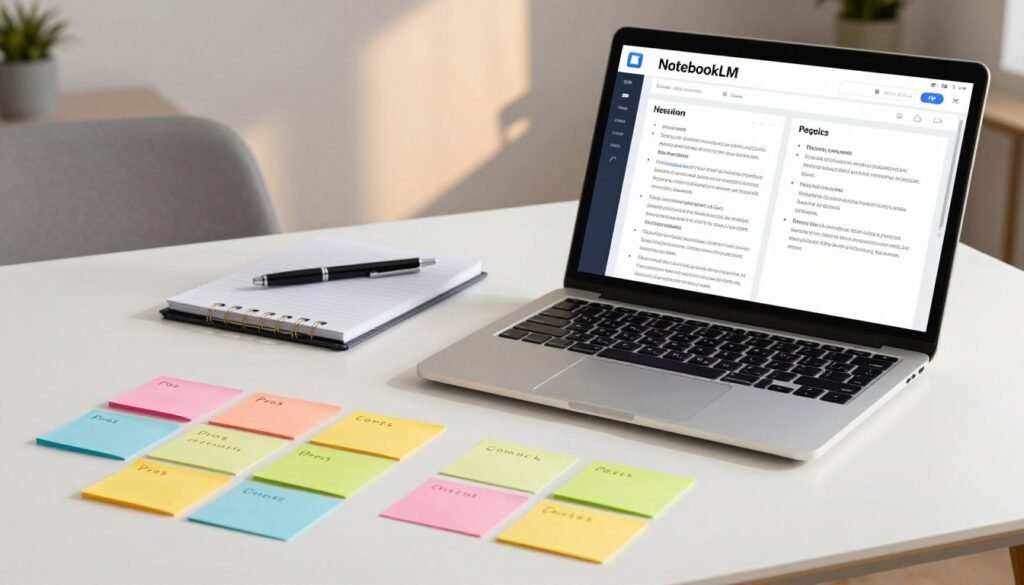
But, there are also some downsides to consider. One is the file size and quantity cap. This might be a problem for those who need to work with a lot of data at once. Also, the tool needs an internet connection to work. This can be a challenge in places without Wi-Fi.
Even though the AI is very accurate, it’s not perfect. You should always check important information. This is because the system can sometimes get complex details wrong. It’s important to keep a critical eye when reviewing AI summaries.
| Feature Category | Key Benefit | Potential Limitation |
|---|---|---|
| Data Integrity | Strict source grounding | Occasional interpretation errors |
| Privacy | Private data handling | Cloud-based dependency |
| Usability | Intuitive interface | File size constraints |
In the end, this tool is great for those who value accuracy and privacy above all else. By considering these points, you can decide if it’s right for your current project.
Frequently Asked Questions
We’ve collected the most common questions to help you use this powerful tool. Whether you’re a student or a professional, knowing how to use a notebooklm ai study tool is key. It’s about understanding its strengths and weaknesses.
Many ask how to organize their info for the best results. Think of this section as your quick notebooklm study guide. It helps keep your workflow smooth and productive.
“The secret to effective research is not just gathering data, but organizing it in a way that allows for meaningful insights.”
Here are answers to the most common questions about the platform:
- Is my data secure? Yes, your uploaded documents are private and not used for public AI training.
- What file types are supported? You can upload PDFs, text files, Google Docs, and even copy-pasted web content.
- How do I fix sync errors? If a document fails to load, try refreshing your browser or checking your internet connection.
If you run into problems during analysis, check if your files are not password-protected or corrupted. A good notebooklm ai study tool experience needs clean, readable files.
Always have your notebooklm study guide ready to solve minor issues. By following these tips, you’ll spend less time fixing problems and more time getting deep insights from your research.
Final Thoughts
Mastering Google NotebookLM gives you a big advantage in research and document management. You now have the tools to change how you deal with complex information.
Using these strategies can make you more productive. You’ll also get deeper insights from your data. As you use this AI tool every day, you’ll get better at handling lots of text.
Start using it with your own documents to see how it changes your work. This tool is a big change in how we handle knowledge online.
Keep exploring what Google AI can do. Your journey to better note-taking starts with your first notebook today